

Analysis as of 12 September 2026 | Al Banyan Tree Research
Saudi Arabia’s precautionary shutdown of its East–West Pipeline puts the UAE’s Fujairah pipeline in sharper focus. The announcement concerns the Saudi asset, not ADCOP. For buyers and shipping desks, the useful question is how much additional, deliverable crude the UAE route could provide—not its headline capacity alone. Saudi Press Agency
What changed on 11 September?
Saudi Arabia’s energy ministry said attacks on 10 September prompted the shutdown while teams assessed safety. Its 11 September statement gave no restart timetable or quantified export loss. That leaves outage duration and the effect on actual cargo deliveries unresolved in that announcement. Official statement
Our assessment is that pressure on one bypass route increases the importance of testing the alternatives. It does not establish that another route is operating normally, has unused capacity or can substitute for the affected barrels on a one-for-one basis.
Our assessment is that pressure on one bypass route increases the importance of testing the alternatives. It does not establish that another route is operating normally, has unused capacity or can substitute for the affected barrels on a one-for-one basis.
Three pipelines, three different questions
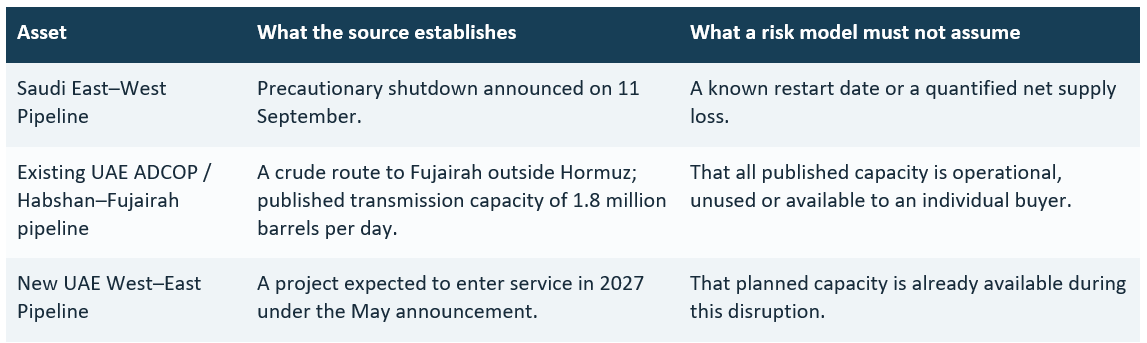
Sources: Saudi Ministry of Energy via SPA, Port of Fujairah and Abu Dhabi Media Office, 15 May 2026.
ADCOP means Abu Dhabi Crude Oil Pipeline. ADNOC describes its route from Abu Dhabi to the Fujairah export terminal; the port identifies the cargo as Murban crude from Habshan. These descriptions do not imply that any disrupted Gulf cargo can simply be redirected into the system. ADNOC; Port of Fujairah
ADCOP capacity is not spare export capacity
The IEA distinguishes original nameplate capacity of 1.5 million barrels per day from reported capacity near 1.8 million. Neither figure, by itself, measures spare export headroom on 12 September. IEA infrastructure profile
The distinction matters twice. First, some capacity may already be used. Second, the limiting factor may be outside the pipe: available crude, storage handling, loading facilities or vessels able to complete the lifting. A route outside Hormuz still needs a functioning end-to-end delivery chain.
For a transparent steady-state scenario model, define:
Deliverable export rate = minimum of available crude, usable pipeline capacity, usable terminal throughput and achievable vessel liftings.
Additional headroom = maximum of zero and the difference between that deliverable rate and baseline exports.
All inputs must use the same time horizon and unit, such as barrels per day. This simplified model excludes temporary inventory drawdowns, which should be modelled separately.
For illustration only, suppose baseline exports are 1.4 million barrels per day and the weakest link allows 1.6 million. Additional headroom would be 0.2 million barrels per day, not 1.8 million. These are hypothetical inputs, not estimates of current ADCOP operations. If the deliverable rate fell below baseline, the result would instead be an export shortfall; the headroom calculation alone would not describe that loss.
The 2027 UAE project is not an immediate offset
On 15 May, Abu Dhabi Media Office said ADNOC’s new West–East Pipeline was under construction, expected to operate in 2027 and intended to double ADNOC’s export capacity through Fujairah. Official project announcement
That is a prospective infrastructure addition, distinct from the existing ADCOP system. The sources reviewed for this note do not establish its commissioning. A near-term supply balance should therefore not count its planned capacity as available barrels.
Three scenarios for commercial exposure
The following are conditional stress tests, not forecasts or probability estimates.
Saudi service resumes and shipping conditions stabilise. Reassess the physical disruption allowance against verified restoration and completed cargo liftings. Do not infer that pipeline restart instantly clears loading backlogs or reverses every delivery cost.
The Saudi outage persists while Fujairah remains usable. Test how much incremental UAE crude can actually be supplied, scheduled and lifted. Grade suitability, supplier allocation and delivery timing determine whether a buyer can use the alternative; regional capacity alone does not.
The outage persists and Fujairah faces an additional constraint. Reduce the effective export rate to reflect the binding limit, whether at the pipeline, terminal or vessel stage. Run a separate case for higher logistics costs without a throughput loss: a more expensive route is not necessarily a closed route.
What oil buyers and shipping desks should measure
A useful exposure assessment separates the crude benchmark from grade differentials, freight, bunker costs, insurance, delay and working capital. Otherwise, a model can show a well-hedged oil price while missing a material increase in delivered cost or a failure to deliver on time.
The operational evidence should include confirmed cargo nominations and loading performance, terminal restrictions, vessel availability, insurance terms and feasible alternative supply. Changes in these inputs should drive the scenario update; an infrastructure capacity headline is not enough.
For background on the asset, see our ADCOP pipeline guide: route, capacity and ownership. For the analytical work behind exposure assessment, explore our commodity hedging services and commodity price forecasting solutions.
Bottom line: ADCOP provides a route outside Hormuz. Its ability to offset a separate supply disruption depends on incremental, usable and commercially accessible barrels. Published capacity is a starting input—not proof of spare supply.
Source and method note: This analysis combines the dated official statements and infrastructure profiles linked above with an original analytical framework. It does not establish real-time ADCOP throughput, spare capacity or a Saudi restart date. Infrastructure profiles are not live operating reports. The numerical example and scenarios are illustrative, not forecasts. This material is for professional market analysis and is not an individual investment recommendation.